SPIN COATER BUYING GUIDE
How to Choose and Buy a Spin Coater
A practical guide to matching equipment to your substrates, chemistry, facility, budget, and process requirements.
Published by Cost Effective Equipment. Cee® manufactures spin coaters and related wafer processing equipment. The selection criteria below can be used to evaluate equipment from any supplier. A separate section explains where Cee® equipment may fit.
Technical review: Cee® Applications Department.
Introduction
Selecting a spin coater is about more than a target RPM or purchase price. In real coating processes, consistency matters. Film uniformity, process stability, and long-term repeatability all depend on the system behind them.
Whether you’re in a university lab, developing materials, or supporting production, consider how chucking, recipe control, dispensing, exhaust, and installation fit your larger process. Look for the control depth and system architecture to accommodate growing requirements, backed by reliability, service, and long-term support. Use this guide to define your needs and compare equipment and suppliers.
03 / COMPARE
Cost and support
Engineering value, ownership costs, and supplier support.
04 / PREPARE
Your purchase
Capture your requirements and prepare your supplier inquiry.
BEFORE YOU CHOOSE
Consider the whole picture.
Then choose the equipment.
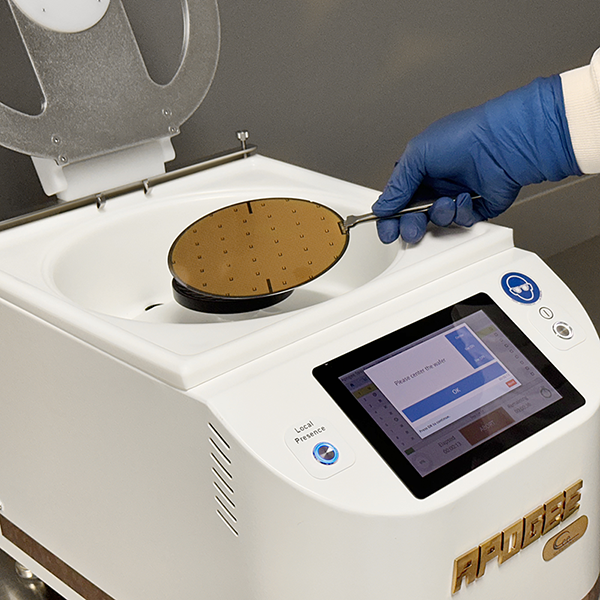
Clarify the results you need, the substrates you’ll coat, and the materials involved. Compare the equipment configuration, cost, and support around those needs, and distinguish the capabilities you need at installation from those you may want later.
New to the technique? Start with spin coating theory.
01
DEFINE YOUR REQUIREMENTS
Start with the basics
Start with the coating results you need and the conditions the equipment must support. Research and production spin coaters are often configured around the application, facility, and workflow. Establish the points below before comparing systems; include known future needs and flag anything still being developed.
Take the requirements with you
Use this personal worksheet to work through coating targets, substrates, chemistry, recipe details, facilities, workflow, and future needs. Type into the fields or print it, and keep your completed copy for your own reference.
Share what you know. A development process may not yet have a complete recipe, final chemistry, or fixed settings. Identify those unknowns so the supplier can help clarify options. If trade secrets or confidential process details are a concern, a good supplier should be willing to arrange a nondisclosure agreement (NDA) before you share them, so the discussion can proceed under agreed confidentiality terms. Distinguish capabilities needed at installation from those you may want later.
02
EVALUATE THE EQUIPMENT
What matters in a spin coater
Once your requirements are clear, compare how each system controls the coating process, fits the workflow, and remains supportable over time. Maximum RPM alone does not establish film quality or repeatability.
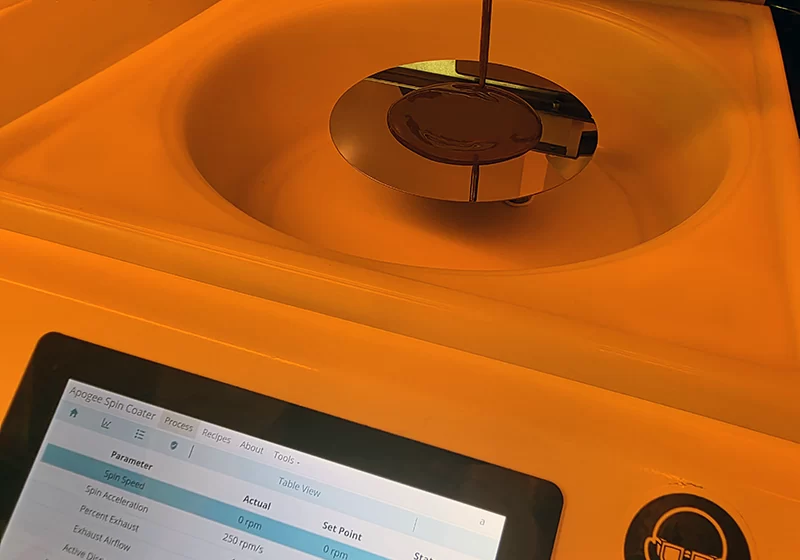
When reviewing coating results, look for the substrate, chemistry, chuck, dispense method, recipe, measurement method, and environmental conditions that make the result interpretable. Previous results are useful context, but they do not establish performance for every process.
03
PLAN THE INSTALLED FOOTPRINT
Where will your spin coater be installed?
Choose the installation format around your facility and workflow. Review the installed footprint, utilities, lid travel, cleaning access, and service space, including where the equipment fits within the cleanroom or laboratory layout.

Benchtop
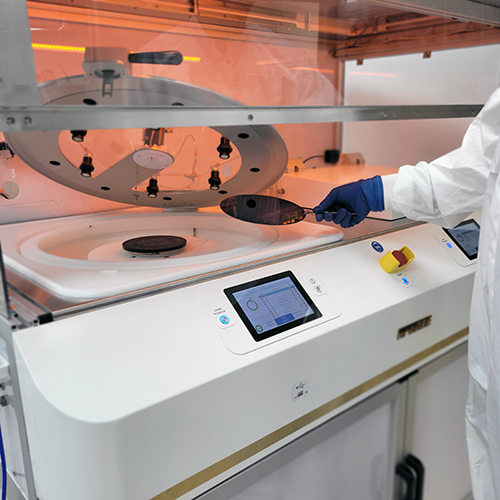
A benchtop instrument can suit a laboratory with an appropriate supporting surface and the required utilities and containment. Check the full operating footprint, lid-open clearance, rear connections, equipment weight, and access for cleaning and service.

Flange mount or in-deck installation
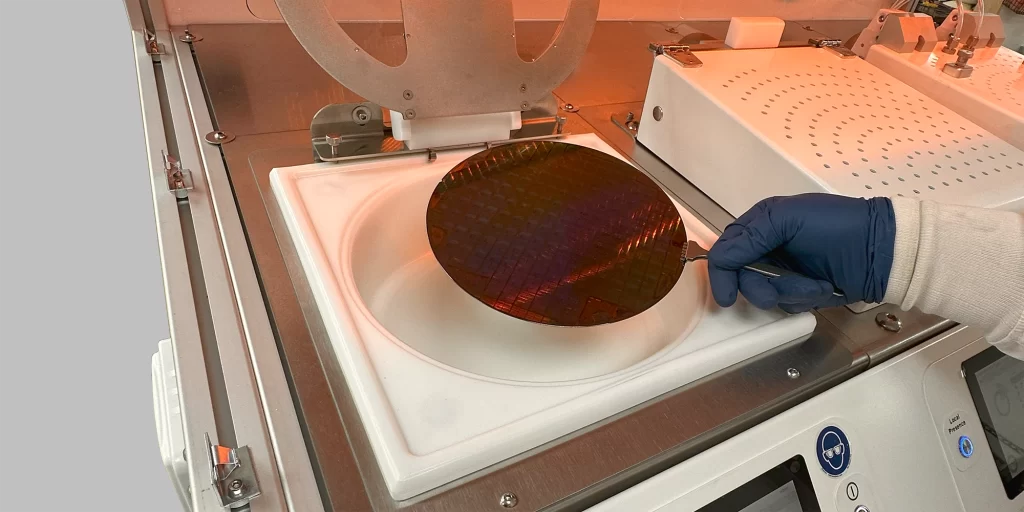
A flange-mounted process module can be incorporated into a suitable wet bench, enclosure, or glove box arrangement. Obtain the mounting drawing and verify above-deck dimensions, below-deck space, support requirements, controller location, and service access.

Integrated workstation
A workstation can organize compatible process modules and related operations within one equipment layout. Check which modules, exhaust provisions, controls, utilities, and installation services are included, and which responsibilities remain with your facility or another equipment supplier.
Use installation drawings and model-specific utility requirements to plan the purchase. Confirm the complete operating footprint, above-deck and below-deck space where applicable, utility connections, and access for cleaning and service.
04
APPLICATION AND WORKFLOW
Matching the system to the process
Spin coating supports semiconductor processing, materials science, polymer development, thick films, lift-off, and chemical QC. Requirements vary with material behavior, environmental sensitivity, and workflow.
The references below describe specific applications and installations. Browse more research using Cee® spin coaters, and use current model documentation to evaluate your proposed configuration.
MATERIALS DEVELOPMENT
Advanced materials and functional coatings
Conductive films, nanomaterials, sol-gels, and specialty polymers can require adaptable recipes, repeatable dispensing, and a stable spin bowl environment. Look for control and configuration options that accommodate changing materials.
Published example
- Thiol–ene polymer coatings (Polymers, 2023): Using an Apogee spin-coater module in an X-Pro II workstation.
LITHOGRAPHY
Photoresists and lithography materials
Evaluate acceleration and deceleration, airflow and solvent evaporation, dispense coordination, and process records. Consistent execution and traceability matter for semiconductor and microfabrication workflows.
Facility examples
- University of Michigan LOR 10A process: a lift-off resist coating process using an Apogee spin coater.
- Stanford Nanopatterning Cleanroom: Apogee spinner for standard electron-beam resists.
HIGH-VISCOSITY COATINGS
Polyimides, dielectrics, and thick films
Review multi-step recipes, material delivery, exhaust conditions, and extended spin sequences. Confirm the usable operating range with the proposed substrate, chuck, and chemistry.
Process reference
- HKUST polyimide coating procedure (PDF): Polyimide on patterned glass using a legacy Cee® Model 100.
SHARED RESEARCH
University and R&D environments
Prioritize flexibility for changing substrates and materials, recipe storage and recall, user permissions, and practical reconfiguration. Consider how the same platform can support future experiments.
University examples
- UCF CREOL Apogee 200: a research cleanroom configuration for coating substrates used in stepper and electron-beam lithography.
- University of Michigan LNF Apogee: a shared-facility example with material restrictions, recipes, and user training.
PRODUCTION SUPPORT
Pilot and low-volume production
Evaluate repeatability, uptime, automation interfaces, process logging, and serviceability. Workstations can bring coating, baking, cooling, developing, or cleaning modules into a coordinated layout.
Workflow resources
- Texas A&M AggieFab X-Pro II: an installed workstation combining two spin coaters with bake and HMDS bake modules.
For non-critical coatings or demonstration work, a basic instrument may meet the need. For continuous high-volume processing and automated wafer handling, assess whether a standalone spin coater, integrated workstation, or track system is appropriate.
05
LIFECYCLE AND OWNERSHIP
Plan for long-term ownership
A spin coater is capital equipment. Look beyond initial performance to how the equipment will remain reliable, serviceable, and useful as processes and requirements change.
Long-term serviceability
Review parts availability, repair arrangements, accessible assemblies, documentation, and support for older systems. Ask for evidence of sustained support. Review product life and support availability.
Platform longevity
Confirm which hardware, software, and integration capabilities can be added to the exact model as requirements grow, and which changes would require replacement.
Mechanical durability
Consider the drive system, chemical compatibility, construction, and maintenance needed for the expected duty cycle and years of use.
Total cost of ownership
Include downtime, maintenance, consumables, integration changes, and eventual replacement alongside the purchase price. Compare value over the equipment’s intended working life.
06
MATCH THE INVESTMENT TO THE WORK
Commodity spin coaters vs. advanced systems
Commodity spin coaters can work well for demonstrations, simple films, and non-critical coatings where basic controls meet the need. Advanced systems are intended for research, development, QC, and production work that calls for coordinated process control, configuration flexibility, and sustained support. Compare the functions and support you actually need, then verify what the proposed system includes.
07
PRICE AND VALUE
What are you actually paying for?
Spin coaters on the market vary widely in price. Look beyond the price tag to the engineering depth behind it: mechanical precision, control architecture, containment, software, build quality, and long-term support.
Two systems may reach the same top RPM yet differ substantially in the process stability they sustain over repeated runs. Compare what is behind the specification and whether it matters to your application.
Pay for capability that serves your process and support that preserves its value. A higher initial price needs a clear explanation in the engineering, included configuration, reliability, or ownership costs. A basic system can be the right choice when it meets the actual requirements.
08
EVALUATE THE SUPPLIER
What to look for in a supplier
The equipment specification is only part of the decision. Look for a supplier that can relate its experience to your application, explain the proposed configuration clearly, and support the equipment throughout its working life.
Relevant process experience
Ask about similar substrates, chemistries, coating requirements, and operating environments. Request results, public research, or application information the supplier is permitted to share, with enough context to judge its relevance.
Clear technical answers
Look for model-specific documentation, defined operating conditions, and candid explanations of limitations. The supplier should distinguish controlled functions from monitoring and identify requirements that remain unresolved.
A credible support history
Review warranty terms, repair arrangements, documentation, parts availability, software support, and experience supporting older equipment. Ask how service is delivered and who will help after installation.
A transparent proposal
Expect a clear model and configuration, included accessories and options, exclusions, current lead time, and purchasing terms. Confirm who provides installation, facility preparation, and training, and identify any recurring charges.
A useful supplier conversation should leave you with a clear proposed configuration, documented assumptions, and a plan for resolving open questions before ordering.
EVALUATING Cee® EQUIPMENT
Where Cee® equipment may fit
Cost Effective Equipment manufactures precision wafer processing equipment for universities, research and development, and low-volume production. Cee® engineers, assembles, and supports its equipment in the United States.
Cee® systems are generally built to order. The platform, process options, and installation format are configured around your application and facility requirements. Start with the substrate range and coating process, then discuss the configuration that fits your needs.
For workflows beyond coating, Cee® also offers bake plates, spin developers, integrated workstations, and temporary wafer bonding and debonding equipment.
PLATFORM SELECTION
Apogee® 200
Consider the 200 platform when your substrate range fits within 200 mm round or 6 × 6 in square and the proposed configuration supports your chemistry and process.
Explore the Apogee 200 Benchtop for a standalone installation or the Apogee 200 Flange-Mount for integration into a suitable bench or enclosure.
PLATFORM SELECTION
Apogee® 450
Consider the larger 450 platform for substrates beyond the 200 range, up to 450 mm round or 14 × 14 in square. Include substrate thickness, mass, geometry, and required speed and acceleration in the application review.
Explore the Apogee 450 Benchtop or Apogee 450 Flange-Mount.
WORKSTATION CONFIGURATION
X-Pro II
Consider an X-Pro II workstation when coating, baking, or developing should share a planned workspace with coordinated fume control, chemical handling, and operator workflow.
Select the required process modules and review the layout, enclosure, utilities, and waste handling together. Workstation integration is a separate decision from choosing the 200 or 450 spin-coater platform.
Start with Configure Your Equipment or contact Cee® to discuss your process and receive a configuration-specific quotation. Compare the scope, options, delivery estimate, and purchasing terms before ordering.
For ownership planning, review service and support, warranty information, and product life and support availability.
ANSWERS BEFORE YOU ORDER
Common spin coater buying questions
What spin coater should I buy?
Choose a system that supports your substrates, chemistry, process sequence, facility, and workload. Define those requirements first, then compare configurations, documented capabilities, ownership costs, and supplier support.
Where can I buy a spin coater?
You can buy a spin coater from an equipment manufacturer or a specialist supplier. Choose one that can match the equipment to your substrates, chemistry, process requirements, facility, and support needs.
To buy a Cee® spin coater for a university laboratory, R&D, or low-volume production, start with Configure Your Equipment or contact Cee®. Cee® generally builds to order, configuring the equipment and options around the application rather than offering a single fixed configuration.
Do I need the highest RPM?
Not necessarily. A spin coater’s maximum RPM may exceed what your coating material and process require. Focus on stable, repeatable control within the speed range you will actually use. Think of a car capable of 160 mph: you might normally drive it at 70 or 75 mph and never use its top speed. The maximum alone tells you little about how well it performs in everyday use. Likewise, evaluate speed stability, acceleration and deceleration, step and dispense timing, exhaust conditions, and operating limits with your actual substrate load. Higher maximum speed should serve a specific process requirement.
Do I need automated dispensing or extensive data logging?
Those capabilities should serve a defined requirement. Consider whether dispensing consistency, coordination, troubleshooting, multiple users, or process records justify them. Confirm which functions are included and which are optional.
How much does a spin coater cost?
There is no single price for all spin coaters. Cost varies with configuration and supply scope. Obtain comparable quotations that identify the instrument, necessary chucks and accessories, facility preparation, delivery, support, and any ongoing charges.
What if a supplier cannot share customer process results?
Confidentiality agreements may restrict what can be shared. Ask about relevant process history and any permitted anonymized examples, public research, or general application information. Evaluate that information alongside model-specific documentation and the proposed scope.
Should I consider a used spin coater?
A used system may be suitable if its condition, configuration, documentation, safety provisions, and support meet your requirements. Verify the exact model, included accessories, repair needs, parts availability, and installation costs before comparing it with new equipment.
Can I expand a system later?
Ask which capabilities can be added to the exact model being quoted. Confirm the required hardware, software, facility changes, and service work. Do not assume that every option is a future upgrade or that every process can be accommodated without replacement.
What should I expect when buying equipment from Cee®?
Cee® equipment is generally configured and built to order around your process and facility requirements. The usual buying process is:
- Start your configuration. Use Configure Your Equipment or contact Cee®.
- Discuss your application. Review substrates, materials, target results, known process details, facility needs, and any open questions.
- Review your quotation. Confirm the proposed model, options, included equipment and accessories, scope, delivery estimate, and purchasing terms.
- Place your order. Submit the purchase order after resolving the configuration and commercial details.
- Prepare for delivery. Cee® builds and ships the agreed configuration. Use the applicable installation documentation to prepare your site and review available support.
YOUR NEXT STEP
Continue your selection
Use your requirements worksheet and supplier evaluation to identify the equipment that fits your process. Resolve configuration and installation questions before finalizing the purchase.
For additional technical background, explore the spin coating process guide. To evaluate Cee® equipment against your requirements, compare Apogee spin coaters or contact Cee® about your application.